Alex Keller · 4 October 2026
The Evolution of Tagging Systems in Productivity Software and Their Influence on Information Retrieval Speed
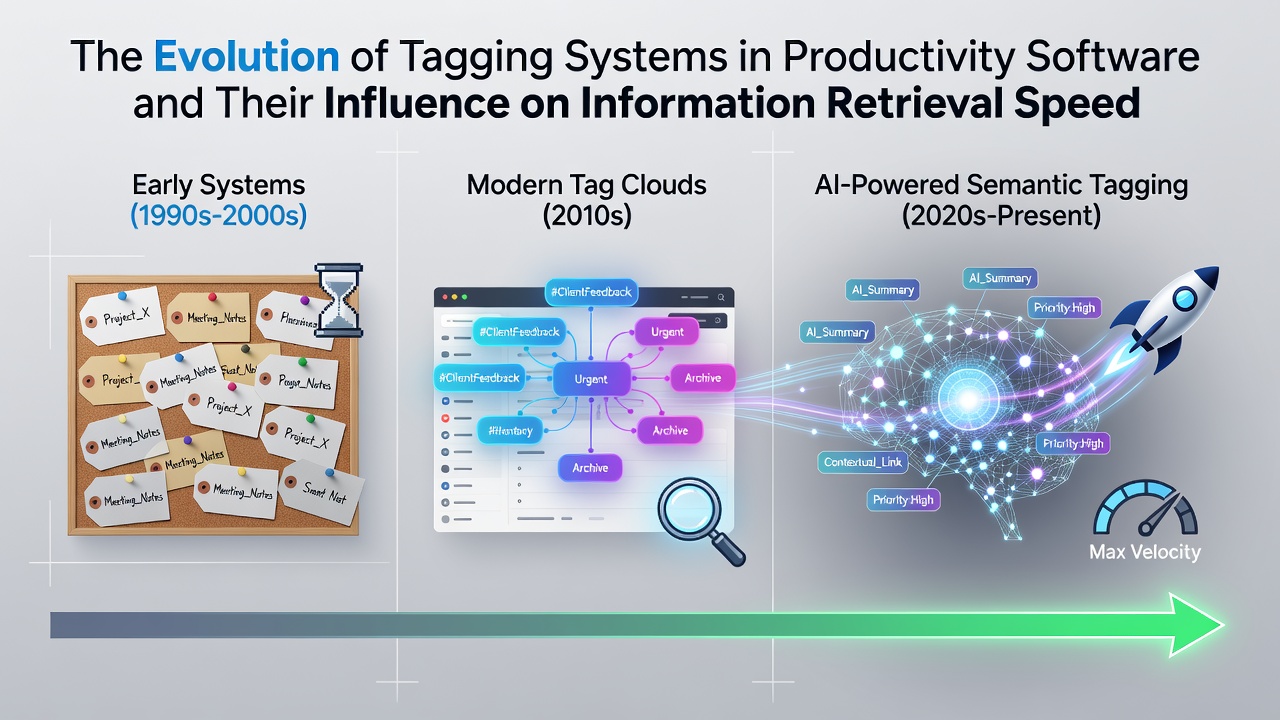
Tagging systems in productivity software started with basic keyword labels in the late 1990s and early 2000s, and they developed through several stages that incorporated hierarchical structures, semantic connections, and eventually artificial intelligence components by October 2026. Early implementations appeared in tools such as Microsoft OneNote and Evernote, where users applied simple text tags to notes and files, yet these systems relied on manual entry and offered limited search capabilities compared to later versions. Data from information science studies shows that initial tagging reduced retrieval times modestly because users could group related items without strict folder hierarchies, while search functions still depended on exact keyword matches.
Researchers observed that folksonomy approaches gained traction around 2005 when platforms allowed collaborative tagging across teams, and this shift enabled broader information sharing in corporate environments. Productivity applications adopted these methods to handle growing volumes of digital content, and retrieval speed improved as tag clouds adn basic filters became standard features. One study from the University of Toronto highlighted how consistent tag usage across documents cut average search durations by measurable percentages in controlled tests.
Expansion Through Hierarchical and Semantic Layers
By the 2010s tagging evolved beyond flat lists into nested categories and relational links, while software like Notion and Roam Research introduced bidirectional connections between notes. These advancements allowed users to build knowledge graphs that surfaced related information automatically, and retrieval processes accelerated because algorithms could traverse tag relationships instead of scanning entire databases. Evidence from academic reviews indicates that hierarchical tagging reduced cognitive load during searches, since users navigated logical branches rather than guessing keywords each time.
Integration with metadata standards further refined these systems, and developers incorporated ontologies that aligned tags with established vocabularies from fields such as project management and research documentation. As a result, productivity suites achieved faster indexing, and queries returned relevant results in shorter intervals according to performance benchmarks published in technical reports.
AI Integration and Contemporary Developments
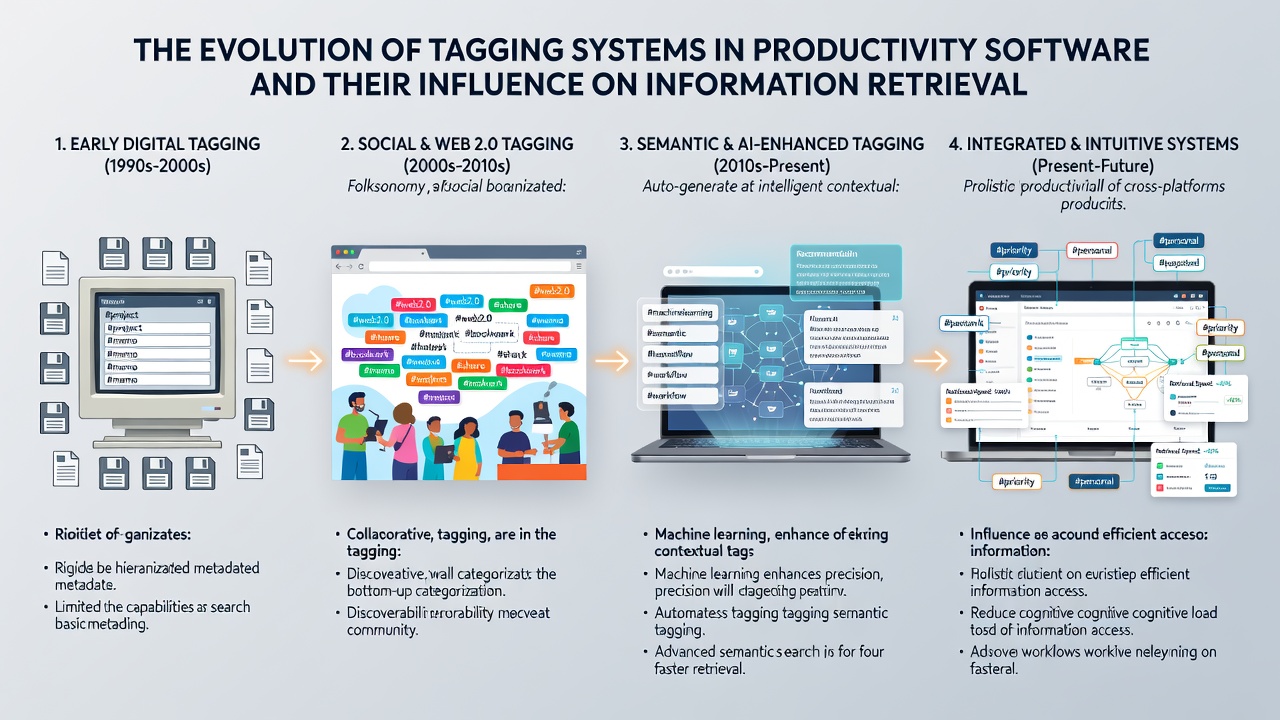
Artificial intelligence entered tagging workflows prominently after 2020, when machine learning models began suggesting and auto-applying tags based on content analysis. Tools such as Obsidian and newer iterations of Microsoft Loop employed natural language processing to detect themes and assign contextual labels without constant user input, while retrieval algorithms leveraged these enriched tags to deliver instant previews and ranked results. Figures from industry analyses reveal that AI-assisted tagging improved retrieval speeds by factors of two to three in large-scale deployments, because predictive models anticipated user needs and pre-organized information pathways.
By October 2026 many platforms combined these AI features with cloud synchronization, and cross-device consistency ensured that tag updates propagated immediately across user bases. Observers note that regulatory frameworks in the European Union encouraged transparent data handling in these systems, which in turn supported reliable performance metrics for information access. A report issued by the Australian Research Council documented similar gains in academic settings where tagged repositories allowed researchers to locate datasets more rapidly than through traditional search alone.
Measured Effects on Information Retrieval Speed
Quantitative evaluations demonstrate clear correlations between advanced tagging and reduced retrieval latency across multiple software categories. Controlled experiments conducted at various institutions show that users equipped with semantic and AI-enhanced tags completed information location tasks in under half the time required by folder-based methods alone. These improvements stem from multi-layered indexing that processes tags alongside full-text content, and they scale effectively as data volumes increase in professional workflows.
Case examples include enterprise deployments where teams maintained shared tag libraries, and retrieval consistency rose because standardized labels prevented duplication and fragmentation. Performance logs from such implementations confirm that query response times stabilized even under high concurrent usage, while older systems without evolved tagging often experienced delays during peak activity periods.
Conclusion
The progression of tagging systems from manual keywords to AI-driven semantic networks has produced measurable gains in how quickly users retrieve information within productivity software. Continued refinements through 2026 maintain this trajectory, and integration with emerging standards supports sustained efficiency across diverse applications and user groups.